TLDR: Pack food you can eat with one hand, keep it under 5 degrees until you serve it, and remember the safety clock starts in your kitchen, not at the wharf. On a chartered boat, most of the gear you would pack for a picnic is already on board, including eskies.
Almost every guide to boat food was written for someone driving their own boat on an American lake. A chartered day on Sydney Harbour is a different exercise: there is a skipper, a fixed boarding time, a three or four hour window, a wharf to carry everything down, and in summer, a deck sitting well above thirty degrees.
This is how we would do it, after two decades of watching people board with too much of the wrong thing and not enough ice.
Start by asking what the boat already has
This is the step that saves the most money and the most carrying, and no general boat-food guide can tell you the answer, because it depends on your vessel.
On our private charters, a BYO boat comes with eskies for your drinks and food that needs to stay chilled. Liaise with your event manager to check if the boat provides the ice and the cutlery & crockery and whether the cutlery & plates are disposable. Many of the catamarans carry an onboard BBQ. Bathrooms and a galley kitchen are standard. If you are bringing an esky to carry your drinks, a soft esky or lined bags are strongly preferred over a hard esky. So the esky you were about to buy, the paper plates and the plastic cutlery are usually all unnecessary, and often you are simply duplicating what is already sitting on the deck.
Ask four questions when you book: how large is the esky, is ice provided, is there a BBQ and can we use it, and are plates and cutlery on board. Then pack to the gaps. If you would rather skip the shop entirely, our catering menus cover canapes, platters, lunch and dinner, and drinks can be pre-ordered and delivered to the boat in eskies, cold and waiting when you board.
The food that actually works on a boat
The test is simple. Can someone eat it standing up, with one hand, on a deck that is moving, while holding a drink in the other? If yes, pack it.
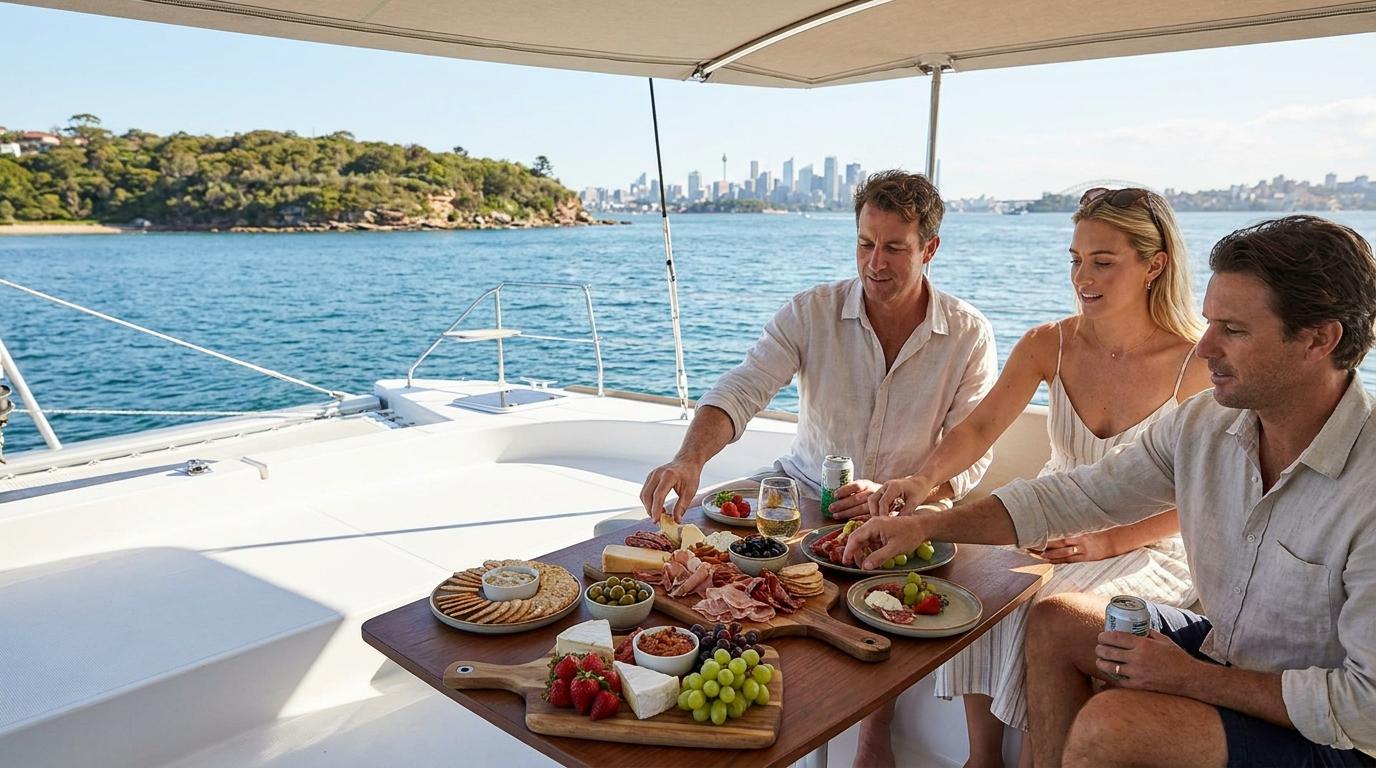
Grazing platters are the default for good reason: cheese, cured meats, crackers, dips, olives and nuts need no preparation, no cutlery and no reheating, and they hold a crowd for hours. Wraps and mini rolls beat full sandwiches, because they hold their shape in an esky and you can eat one without a plate. Skewers work beautifully, whether that is tortellini and bocconcini, cherry tomato and basil, or fruit. Cold salads that do not wilt, like a grain or pasta salad, are sometimes better than leafy ones.
Frozen grapes are the single best thing on this list. They come out of the freezer the night before, act as extra cooling mass in the esky on the way down, and by mid afternoon they are the most popular thing on the boat. Whole fruit, muffins, slices and crackers are all genuinely low risk, which matters for reasons we will get to.
Fruit platters, cheese platters and chips & nuts are very popular nibbles and easy to serve.
For a Sydney charter specifically, prawns and seafood are what people want and what we are asked about most. Make sure seafood is kept chilled on ice in the esky, serve it in the first hour, and do not put the leftovers back.
If you are choosing the BBQ option, it is best to avoid large steaks & meats due to the limited size of boat BBQs and the breeze factor in the BBQ plate. The BBQs on boats are better suited to smaller items such as kebabs, skewers, smaller meat patties, marinated chicken, etc. Finger food style is better than large plates with knife and forks and plates.
What to leave at home
Chocolate and ice cream do not survive a Sydney summer deck. Anything with coloured powder on it leaves orange handprints on upholstery that is not yours. Red wine, is a nono on some boats with white or teak decks. Also cola and coffee stain decks and cushions, so dark drinks are worth a second thought.
Whilst not prohibited, glass is an item to be careful with. A dropped bottle on a deck means bare feet and broken glass in the same place, and most operators will ask you to avoid it. Cans, cartons and tumblers do the same job.
Beyond that, skip anything needing a knife and fork, anything that has to be cooked other than on the BBQ, and anything greasy, heavy or very spicy if you have guests who are unsure about the water. Light food sits better than rich food when there is any movement at all.
The part nobody tells you: the clock starts in your kitchen
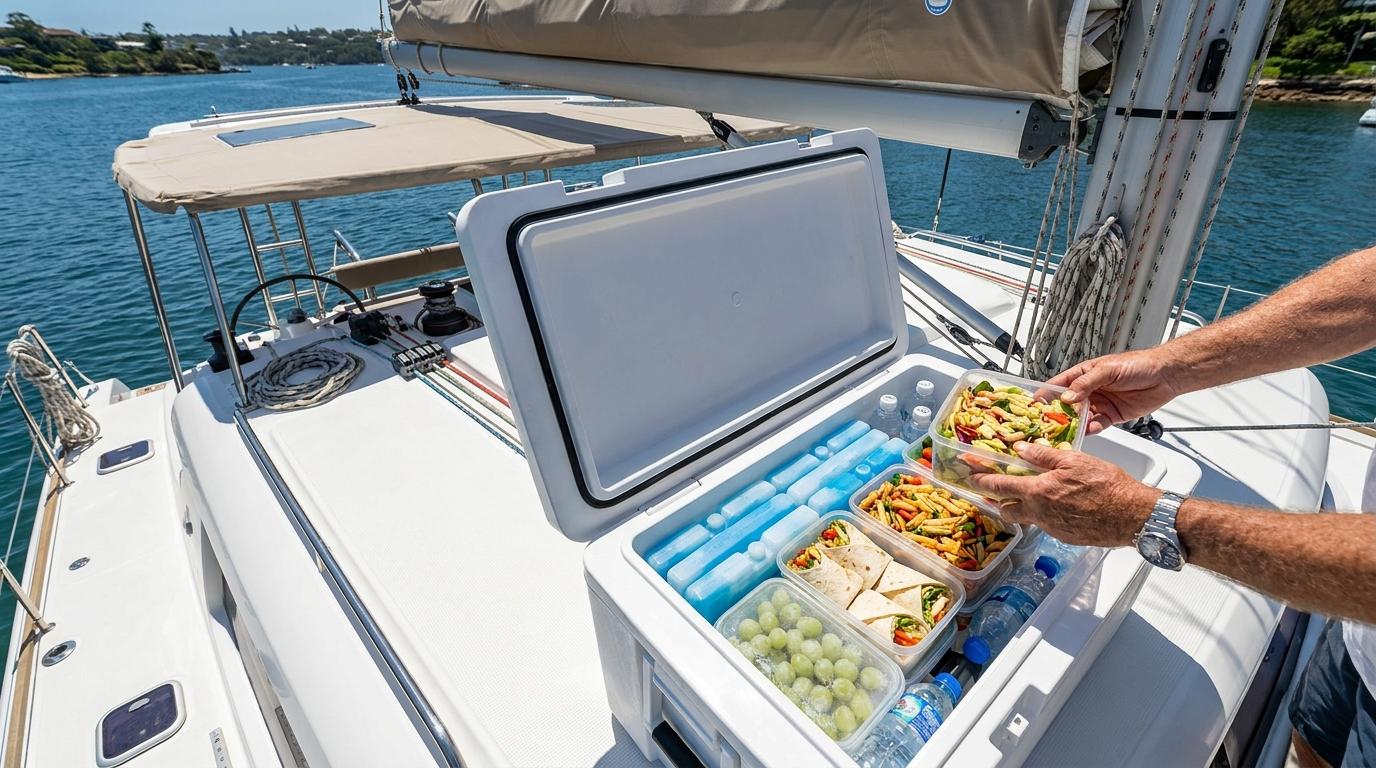
Tips for keeping your food safe, fresh and tasty onboard in summer: remember that the time food spends out of the fridge is cumulative, including preparation, storage and transport to the wharf. Chill everything thoroughly before leaving home, use ice bricks between the layers rather than loose ice, and pack the food you plan to serve last at the bottom so the esky is not opened repeatedly. Important your seafood, and BBQ meats are kept iced and chilled onboard until served.
Drinks, water and the sun
Bring more water than you think you need, and more than the people who said they would only drink beer think they need. A deck in summer is hotter than the forecast, there is no shade on an open bow, and the reflection off the water doubles the sun you are getting. Electrolyte drinks earn their place on a long day.
Keep drinks in a separate esky from the food. A drinks esky gets opened every few minutes, which is exactly what you do not want happening to the esky holding your prawns. Freezing a few bottles the night before gives you both extra cooling and cold water later.
If your charter includes a swim stop, which most of our daytime cruises can, pack as though you are going to a beach with no kiosk, because you are. Our guide to what to wear on a Sydney cruise covers the rest of the kit.
Getting it all down the wharf
Charters board at a set time and the wharf slot is often required to be booked, so the boat cannot wait while someone goes back to the car. Pack in fewer, heavier containers rather than many light ones, and bring one person’s worth of hands spare. Avoid large hard eskies.
Use containers that lock rather than ones with a resting lid, because a lid that pops on a wave puts your lunch on the deck. Stackable is better than big.
If the day involves a lot of food, it is worth asking your planner which wharf you are leaving from. Some have a long walk from the carpark and some do not, and the list of Sydney wharves is longer than most people expect.
BYO or let someone else do it
BYO is the cheaper option and it is what most of our smaller boats and catamarans run on, with BYO generally available for groups under fifty guests. You control exactly what is served and what it costs, and with the fridges, eskies, ice and crockery already on board, the gap between a BYO charter and a catered one is smaller than people expect.
Catering makes more sense when the day has a job to do. A corporate charter where you are hosting clients is not the moment to be carrying an esky down a wharf, and for a larger party boat the logistics of feeding forty people from a cooler stop being fun. Our larger licensed function vessels run their own bar rather than BYO. Catering and final guest numbers are confirmed fourteen days before the cruise, so there is time to change your mind.
FAQ
What is the best food to take on a boat?
Food you can eat standing up with one hand. Grazing platters, wraps, skewers, cold grain salads, whole fruit and frozen grapes all hold well, need no cutlery and do not need reheating. Build around those and add one or two hot things off the BBQ if your boat has one. For BBQ cooking, avoid large steaks and meats.
How long can food sit out on a boat?
Make sure any cold food like seafood, sushi, and meats for BBQ are well chilled before the charter, and iced properly until they are served. Remember the time is cumulative and includes preparation and the drive to the wharf, not just the time on deck.
Do I need to bring my own esky and ice?
On our BYO charters, eskies are supplied. Check with your event manager whether ice and crockery are provided. Most catamarans carry a BBQ as well. The crew will be able to assist with the cooking. Check what your specific vessel has when you book, then pack only for the gaps.
Do I need to remove my rubbish ?
Many boats offer a BYO option which includes rubbish removal. But we are sure the crew will be delighted if you took your own rubbish !
Can I bring my own food and drinks on a charter?
Yes on our BYO boats, which covers most vessels for groups under fifty guests. Our larger licensed function boats run an onboard bar instead of BYO. A BYO fee is often charged to cover the cutlery use, cleaning fees and rubbish disposal. Either way we can arrange catering and have drinks delivered to the boat in eskies, cold and ready for boarding.
What food should I avoid taking on a boat?
Avoid chocolate and ice cream in summer, powder-coated snacks that mark upholstery, dark staining drinks, and anything that needs a knife and fork or a stove. Avoid glass where you can. If anyone in the group is unsure on the water, keep the food light rather than greasy or heavily spiced.
What should I eat if I get seasick?
Eat something light before you board rather than nothing, since an empty stomach makes it worse. Plain crackers, dry biscuits and crystallised ginger all help. Avoid alcohol, coffee and rich food early in the day, and stay on deck in the fresh air where you can see the horizon. If you are prone to seasickness, pack some seasick tablets & take one 30 minutes before the charter.
How much food should I bring?
Cater for the length of the charter rather than for one meal. People graze steadily across three or four hours on the water, especially if they are drinking, and far more gets eaten than at the same gathering on land. If you are unsure, talk to your planner about a catered option and you will get a per-head figure rather than a guess.
Ready to plan the day?
Tell us your date, your group size and whether you want to BYO or have it catered, and we will match you with the right boat and sort the rest. Call 1300 883 023 or send us an enquiry.